Many people are either in denial or in despair about climate change. They either try to convince themselves that it cannot possibly be that bad…or they are resigned to the fact that nothing will stop this massive train from rushing down into the abyss.
Even if it’s too late to avert catastrophic warming entirely, there are enormous immediate benefits to taking action–from cleaner air and water to better jobs to healthier communities.
Future generations will suffer the consequences of our inaction, so they will suffer less the more we accomplish.
I took the photo on the top of the page on a walk around Walden Pond. It’s my favorite place here in Massachusetts. A perfect setting for Henry David Thoreau’s beautiful reminder to us all: “Simplify!”
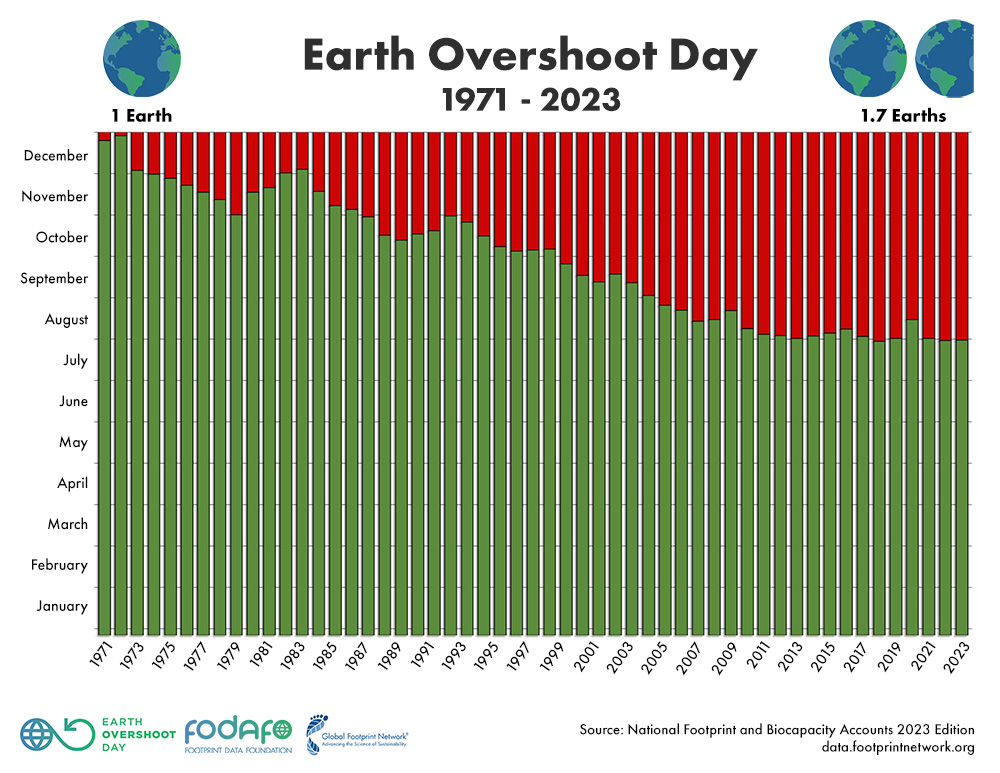
“Earth Overshoot Day marks the date when humanity’s demand for ecological resources and services in a given year exceeds what Earth can regenerate in that year. We maintain this deficit by liquidating stocks of ecological resources and accumulating waste, primarily carbon dioxide in the atmosphere. Earth Overshoot Day is hosted and calculated by Global Footprint Network, an international think tank that coordinates research, develops methodological standards and provides decision-makers with a menu of tools to help the human economy operate within Earth’s ecological limits.
To determine the date of Earth Overshoot Day for each year, Global Footprint Network calculates the number of days of that year that Earth’s biocapacity suffices to provide for humanity’s Ecological Footprint. The remainder of the year corresponds to global overshoot. Earth Overshoot Day is computed by dividing the planet’s biocapacity (the amount of ecological resources Earth is able to generate that year), by humanity’s Ecological Footprint (humanity’s demand for that year), and multiplying by 365, the number of days in 2015:
(Planet’s Biocapacity / Humanity’s Ecological Footprint) x 365 = Earth Overshoot Day
Check out the long list of local and statewide activist groups at the coalition page for Mass Power Forward
350Massachusetts for a Better Future (campaigns: Divestment, Carbon Pricing, ReNEWable Mass) with nodes in the Berkshires, Boston/JP, Cambridge, Greater Franklin, Lowell, Metrowest, North Shore, Newton, South Coast, South Shore.
More Info about Resistance to Gas Pipelines in Massachusetts here.
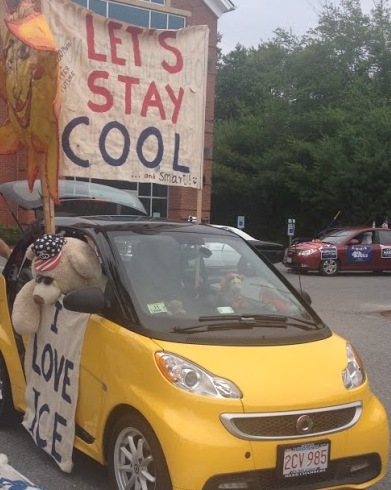
If you are commuting by walking, biking, or using public transport–good for you! If neither is an option for you, consider an electric vehicle: MIT just published a study that clearly shows we can make a big dent in our carbon emissions by driving electric cars.
It’s not just good for the climate. It makes financial sense, too: There are very nice government incentives to getting a new EV.
I am leasing this neat little SMART for three years, and I’ve been saving money like crazy. First of all: I had to pay $2500 down and got the full down payment back through the rebate program.
Apart from insurance ($955/year) and taxes ($350 the first year, $125 the second year) I’m paying $133 a month–no gas, no oil change. After being away for two months this summer I could simply turn the key and drive. No problem.
The main downside of an electric vehicle is the battery range. But most families own more than one car anyway. If you have a family car that you can use for occasional longer trips, an electric vehicle will work perfectly fine for the daily commute. [Mine gets 80 miles on a charge in the summer, and 45 miles in winter.]
The first step towards reducing your carbon footprint is to find out what it actually is. There are many good free carbon footprint calculators online.




 The first step towards reducing your carbon footprint is to find out what it actually is. There are many good free carbon footprint calculators online.
 We Can Stop Climate Change